
Smart Sanitary Solutions Certification: Standards, Testing, and Approval Steps
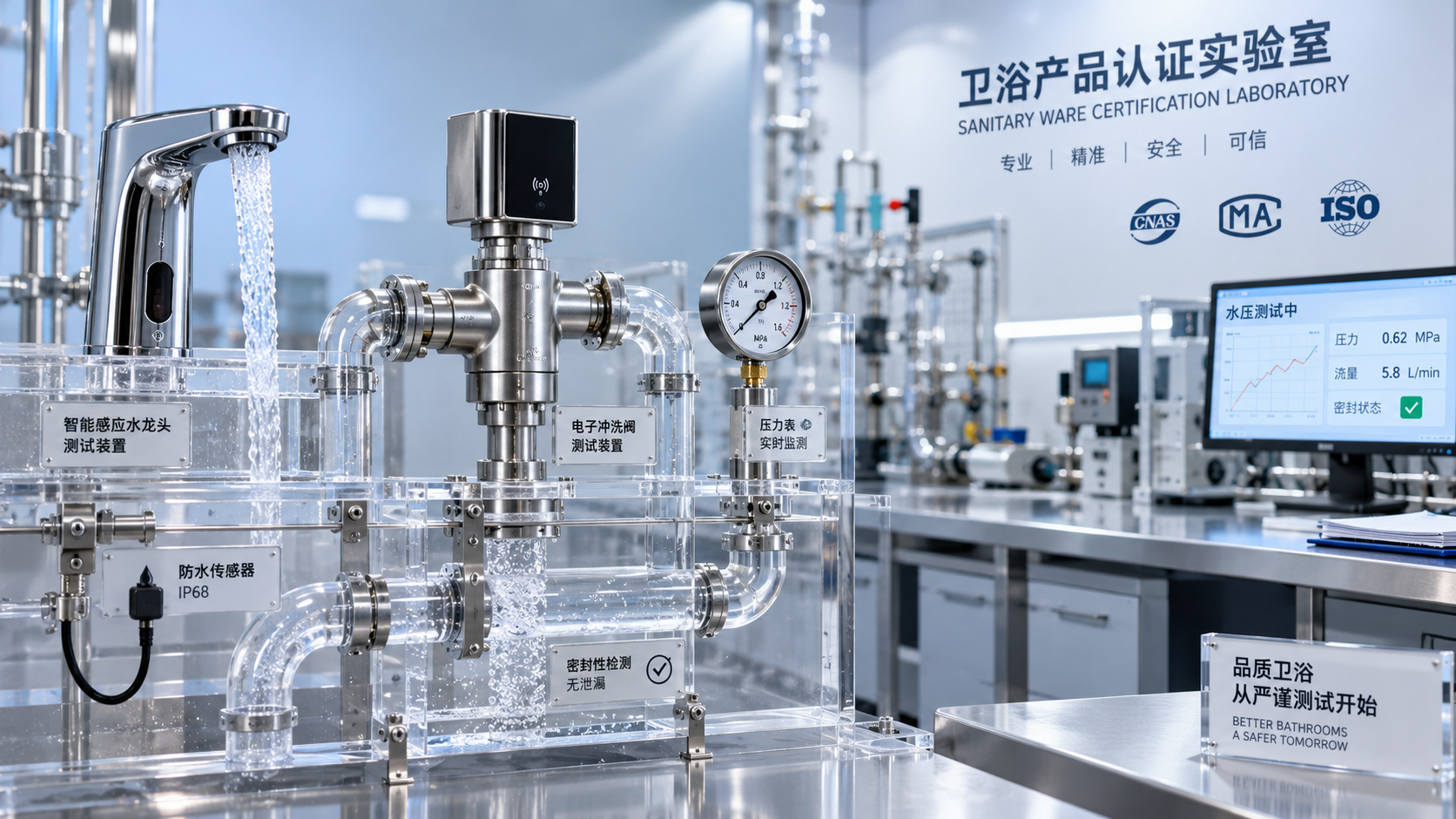
Smart Sanitary Solutions Certification: Standards, Testing, and Approval Steps
Smart sanitary solutions certification is no longer a narrow compliance task assigned at the end of product development. For connected toilets, touchless faucets, sensor-operated flush valves, electronic bidet seats, digital shower controls, leak-detection devices, and water-management platforms, certification sits at the intersection of plumbing safety, electrical safety, hygiene, wireless connectivity, software behavior, and local building rules.
That intersection is where quality and safety teams face their hardest questions. A fixture may perform well in a controlled demonstration but fail to meet the applicable plumbing code pathway. A product may carry an electrical safety mark while its wireless module lacks the required market approval. A water-saving claim may be technically plausible, yet unsupported by the test method expected in a target jurisdiction. Certification is therefore best treated as an engineering-control process, not as a document collection exercise.
The exact route depends on the product architecture and destination market. There is no single global certificate that automatically clears every smart bathroom product for sale or installation. Still, a disciplined approach can prevent late redesigns, shipment holds, rejected project submittals, and avoidable product-safety exposure.
Start by Separating the Product into Compliance Functions
A common mistake is to certify the “smart toilet” or “touchless faucet” as though it were one technical object. In reality, the approval strategy should map each function that creates a regulatory or safety obligation. A sensor faucet, for example, may include a water outlet, solenoid valve, power supply, sensor electronics, battery compartment, firmware, and possibly Bluetooth or Wi-Fi communication. Each layer can bring different requirements.
For sanitary products, the first layer is normally hydraulic and plumbing performance. The assessment may address flow control, pressure resistance, leakage, backflow protection, drainage performance, flushing performance, and compatibility with the intended water supply. The second layer is electrical safety, especially when a product uses mains power, heating elements, pumps, UV features, dryers, control panels, or chargers. The third layer covers electromagnetic compatibility and radio equipment where electronics or wireless communication are present.
There may also be material and chemical considerations. Parts in contact with potable water can require review under destination-market rules or project specifications. Surface hygiene claims, antimicrobial additives, coatings, and cleaning functions need careful substantiation. “Antibacterial” is not a substitute for a test report, and it should not be presented as a broad health claim unless the applicable legal and marketing framework permits it.
This functional decomposition gives quality teams a clearer question: which component, operating mode, and claim must be tested against which requirement? It is far more useful than asking whether the complete product is simply “certified.”
Standards Are Market-Specific, Even When the Engineering Looks Similar
The same product can follow materially different approval paths in North America, Europe, the United Kingdom, the Gulf region, Asia-Pacific markets, or a project governed by a local authority having jurisdiction. Product teams should identify the destination market before selecting a laboratory or freezing the design. Testing against a familiar standard is not enough if it is not accepted by the authority, customer, or insurer involved in the project.
In the United States and Canada, plumbing products are often assessed through standards and certification programs recognized by local codes, project specifications, or authorities. Depending on the fixture, organizations may encounter references to standards developed by ASME, CSA, IAPMO, or other relevant bodies. Water-efficiency programs and local water regulations can add another layer. Electrical equipment may require evaluation by a Nationally Recognized Testing Laboratory in the United States, while Canadian requirements and marking conventions may differ.
For the European Economic Area, manufacturers commonly need to determine whether the product falls within applicable EU legislation for electrical equipment, electromagnetic compatibility, radio equipment, hazardous substances, and other relevant categories. CE marking is a legal conformity framework, not a universal third-party quality certificate. The technical documentation, risk assessment, declarations, test evidence, and responsible economic-operator arrangements must match the product and its route to market. Products supplied in Great Britain may require a separate assessment of the current UK framework.
Plumbing installation requirements are especially local. A fixture accepted in one country may still require a different backflow arrangement, connector type, water-consumption classification, or installation method elsewhere. For safety managers, the practical rule is simple: identify both the product-standard requirement and the installation-code requirement. One does not automatically prove the other.
What Laboratory Testing Usually Needs to Prove
Laboratory evaluation should reflect foreseeable use, not only ideal operation. For a smart sanitary device, testing often begins with construction review: enclosure integrity, wiring, grounding or protective insulation, component ratings, moisture exposure, accessible surfaces, sharp edges, seals, and the relationship between electrical parts and water paths. The evaluator will also examine critical components such as power supplies, heating elements, pumps, solenoids, cords, switches, batteries, and wireless modules.
Electrical testing can include dielectric strength, insulation resistance, leakage current, abnormal operation, temperature rise, and fault-condition assessment, as applicable to the product standard. Products intended for bathrooms require particular attention because conductive water, condensation, cleaning chemicals, and user contact are normal conditions rather than exceptional ones. An ingress-protection rating may be relevant, but an IP code alone does not establish overall product safety.
Hydraulic testing may assess leakage under pressure, endurance of valves and seals, flow performance, flushing effectiveness, drainage, and resistance to pressure variation. The relevant method varies by product type. Teams should avoid treating a single flow-rate measurement as proof of water efficiency; the applicable test conditions, supply pressure, activation logic, and fixture category matter. Sensor-controlled products also need to demonstrate stable behavior when users approach, when reflective surfaces are present, or when ambient light and water droplets interfere with detection.
EMC testing addresses whether the equipment emits unacceptable electromagnetic disturbance and whether it continues to operate acceptably when exposed to expected disturbance. For networked fixtures, radio compliance may apply to the final host device, not merely the pre-approved communication module. Antenna changes, enclosure changes, power changes, or firmware features can alter the assessment position. This is one reason procurement teams should not assume that a module supplier’s certificate closes the entire radio-compliance question.
Software Cannot Be Treated as a Hidden Accessory
A smart fixture’s software can affect water delivery, heating, flushing, fault alarms, user profiles, occupancy sensing, and remote control. Certification scope may not always examine every line of code, but the safety-related behavior must be controlled. Quality teams should maintain version identification, change records, validation evidence, and a defined release process. If a firmware update can change temperature limits, automatic flushing logic, or leak-shutoff behavior, it can also change the product’s compliance assumptions.
Cybersecurity is increasingly relevant in commercial and connected residential environments. It should be considered alongside, rather than confused with, electrical certification. Secure authentication, vulnerability handling, update governance, data minimization, and network segmentation may be demanded by building owners, integrators, or procurement policies even where a conventional product-safety certificate does not explicitly cover them.
A Practical Approval Sequence
The fastest route is rarely the one that sends a finished product to a laboratory and waits for a failure report. Better outcomes come from bringing certification thinking into design review and supplier control.
- Define markets, channels, and installation conditions. Record where the product will be sold, whether it is residential or commercial, the water and power conditions it expects, and who will install it.
- Create a compliance matrix. Link product functions to relevant plumbing, electrical, EMC, radio, material, labeling, and environmental obligations. Include customer specifications and local code references where known.
- Conduct a pre-compliance design review. Resolve predictable issues in component selection, creepage and clearance, waterproofing, valve selection, temperature control, service access, and documentation before formal testing.
- Freeze representative samples. The tested sample must genuinely represent production. Substituting a power supply, valve, plastic resin, sensor, cable, or radio module later can trigger reassessment.
- Complete testing and technical documentation. Keep test reports, drawings, bill of materials, risk assessments, software version records, instructions, labels, declarations, and traceability evidence under document control.
- Plan production surveillance and change management. Initial approval does not protect a product if factory changes silently alter certified construction.
The compliance matrix is the working document that prevents gaps. It should state not only the expected standard or regulation but also the evidence owner, required sample configuration, laboratory status, target date, labeling consequence, and trigger for re-evaluation. This makes it easier to distinguish a completed test from an unresolved approval obligation.
The Documentation That Often Determines Whether Approval Holds
A technically sound sample can still be delayed by weak documentation. Installation instructions are particularly important for smart sanitary products because many failures originate in field conditions: incorrect supply voltage, missing isolation arrangements, unsuitable mounting locations, wrong water pressure, inadequate drainage, improper grounding, or installation outside the permitted wet-zone conditions.
Instructions should use the same assumptions that supported testing. If a product requires a particular protective device, dedicated outlet arrangement, backflow accessory, shutoff valve, maintenance interval, or cleaning restriction, that information should be clear and consistent across manuals, packaging, online materials, and project submittals. Contradictions between a product label and an installation guide create a preventable liability problem.
Traceability also deserves attention. Batch or serial identification, supplier controls for critical parts, inspection records, and procedures for nonconforming products are not administrative extras. They allow a manufacturer to determine which units contain a changed component or software version if a safety issue emerges after shipment.
Frequent Certification Failures in Smart Bathroom Projects
One recurring problem is late market selection. A design may be optimized around a domestic plug, water inlet, or wireless band, then redirected to an export project with different requirements. Another is dividing responsibility between plumbing, electrical, and digital teams without naming an owner for the integrated product. Each department may have valid test evidence, while nobody has verified that the complete system is acceptable.
Uncontrolled component substitution is equally risky. Suppliers often propose equivalent parts to manage cost or availability. Yet “equivalent” in commercial terms may not be equivalent in safety construction, long-term sealing, radio behavior, flame performance, or certification scope. A formal engineering-change process should review all critical substitutions before they enter production.
Finally, teams sometimes confuse certification with field readiness. A compliant product can still fail in service if installers lack clear instructions, facility managers do not understand maintenance requirements, or networked features are deployed on an unmanaged building network. Certification establishes a baseline; safe operation depends on installation, commissioning, maintenance, and controlled updates.
Using Intelligence to Keep Certification Work Current
For businesses operating across construction materials, sanitary spaces, and connected kitchen-and-bath systems, regulatory monitoring should be linked to product strategy. Changes in water-saving requirements, trade conditions, electrical rules, material expectations, and smart-building procurement criteria can affect design choices long before a formal submission is made.
GIAM approaches this wider picture through its Strategic Intelligence Center, bringing together perspectives from material science, hydraulic design, and industrial economics. Its focus on antibacterial materials, water-saving technologies, and intelligent space systems is useful because these features cannot be assessed in isolation. A coating decision may affect material documentation; a water-management function may affect plumbing and software validation; a connected control feature may introduce radio and cybersecurity questions.
The practical objective is not to accumulate certificates. It is to build a defensible chain from product concept to tested configuration, controlled manufacturing, correct installation, and maintained operation. Before approving a launch or project submittal, quality and safety leaders should ask three direct questions: Which market-specific requirements apply? Does the tested product match the unit that will be manufactured and installed? What changes would require the evidence to be reviewed again? Clear answers to those questions are the foundation of credible smart sanitary solutions certification.
Industry Briefing
Get the top 5 industry headlines delivered to your inbox every morning.