
Global Smart Kitchen Systems: Connectivity and Automation Trends
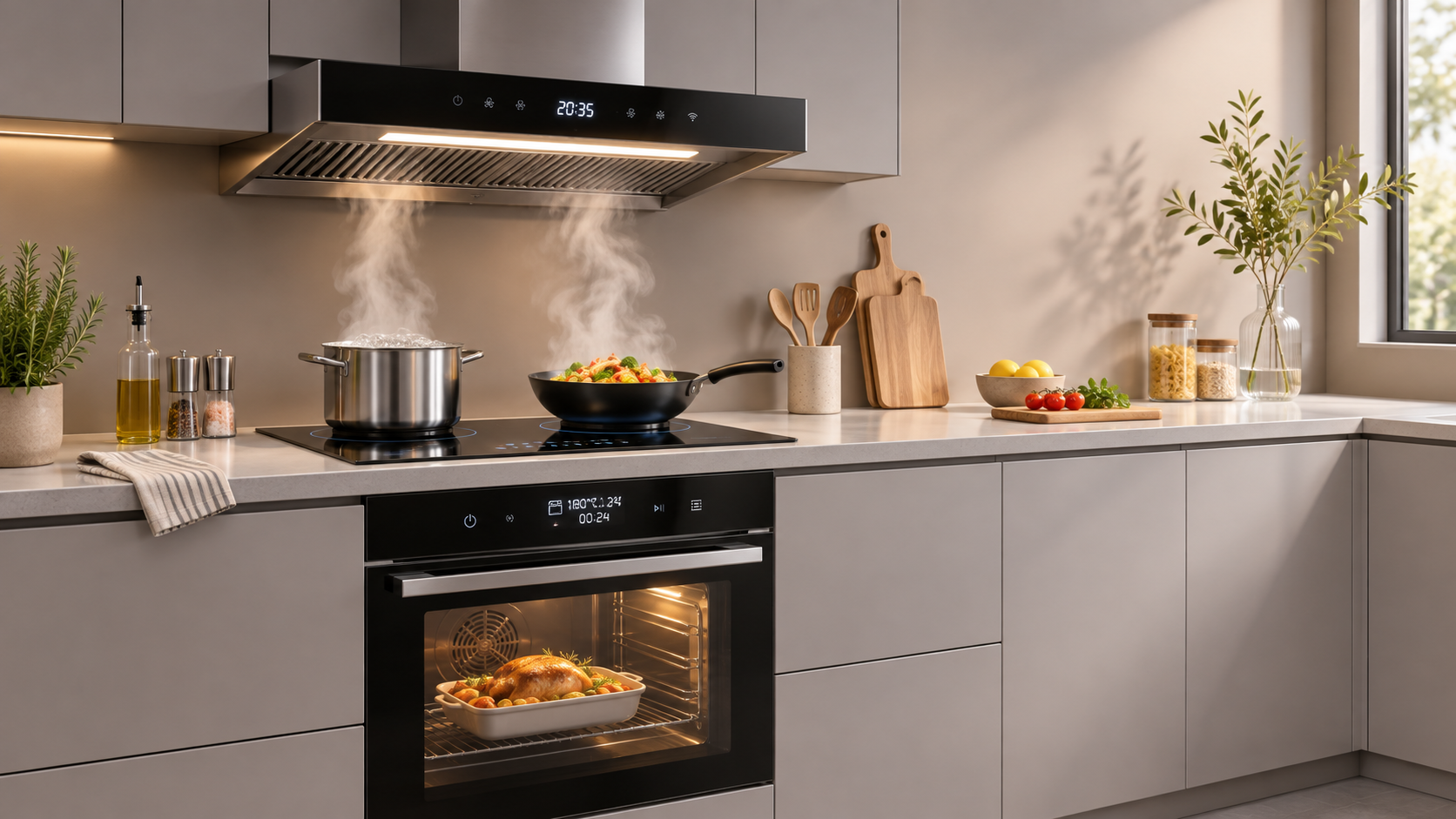
Smart kitchen investment is shifting from individual connected appliances toward systems that coordinate equipment, ventilation, energy use, maintenance, and daily workflows. The strongest commercial propositions are emerging where connectivity solves a recurring operational problem: preventing food loss, reducing unnecessary runtime, identifying faults early, or making a complex kitchen easier to manage. A remote-control feature on its own is a weaker indicator of value.
Across global markets, adoption is uneven because kitchens differ in electrical infrastructure, labor costs, housing formats, connectivity, and purchasing cycles. A connected oven installed during a residential renovation faces different constraints from a networked cooking line in a commercial kitchen. In both settings, the quality of integration and the ability to keep essential functions working without a cloud connection increasingly shape product selection.
From Connected Appliances to Coordinated Workflows
Early connected kitchen features often centered on notifications and remote status. Current development places greater emphasis on relationships between devices: an extractor responding to cooking activity, a refrigerator reporting a temperature excursion, or a cooking appliance adjusting a program using sensor feedback. These functions create value when the response is timely and fits the physical workflow.
Coordination is technically different from simply displaying several products in one app. A shared interface might show whether an appliance is running, while a genuinely integrated workflow exchanges meaningful states and triggers actions. The distinction matters when comparing offers: a system that displays an oven timer does not necessarily understand the cooking phase, and an extractor linked to a hob does not automatically account for steam from another appliance.
Automation also has practical limits. A ventilation response based only on a hob's power setting can miss smoke from an adjacent cooking surface. A camera-based cooking program needs a clear view and consistent lighting; cookware, food placement, and steam can interfere. The strongest specifications describe the conditions under which a feature works, the manual override, and the behavior when sensor data is unavailable.
Interoperability Is Becoming a Purchasing Criterion
Kitchen projects rarely replace every appliance at once. Equipment ages at different rates, cabinetry constrains dimensions, and a renovation may retain a functional refrigerator while replacing the cooking area. For that reason, the ability to connect products across suppliers and generations has a direct bearing on long-term usability.
Compatibility claims require careful interpretation. Two devices using the same wireless network are not necessarily able to exchange commands. Support for a common connectivity framework also does not guarantee that every appliance function is exposed to another controller. A system may allow basic on/off control while keeping advanced programs, diagnostics, or energy data within a separate application.
There are three useful levels of integration to distinguish:
- Shared visibility: device status appears in a common interface, although controls and data remain separate.
- Cross-device control: events from one product trigger a supported action on another, subject to permissions and network availability.
- Operational integration: equipment states, alerts, and maintenance data feed a wider building or facilities workflow through documented interfaces.
The distinction becomes especially important in commercial projects, where a building management system may receive an alarm without receiving the detail needed to identify the affected circuit or appliance. Interface documentation, available data points, polling or reporting behavior, and responsibility for updates all influence whether an integration remains useful after handover.
Local control is gaining importance alongside cloud services. A cloud connection can support remote diagnostics and feature updates, but internet outages or discontinued services can affect features that depend on external servers. A robust assessment separates essential local functions, such as starting and stopping equipment, from convenience functions that require an account or remote service.
Energy Intelligence Requires Context
Energy management is moving beyond a display of instantaneous power. Connected systems can record usage patterns, identify equipment left running, and coordinate selected loads with building energy controls. In residential settings, the appeal may be scheduling a flexible appliance cycle around a time-varying electricity tariff. In commercial settings, visibility into idle periods and refrigeration behavior can inform operating schedules and maintenance.
However, an appliance's displayed consumption is not the same as the kitchen's net energy impact. A more intensive cooking process may increase electricity use at one device while shortening operating time elsewhere. Ventilation, make-up air, hot water, and refrigeration loads also affect the overall picture. Comparisons are most useful when they specify the measurement boundary, operating hours, workload, and whether standby consumption is included.
Demand management has its own constraints. Deferring a dishwasher cycle may be acceptable when clean items are not immediately needed; delaying refrigeration or a time-sensitive cooking process is different. Automated load control therefore needs priority settings and explicit limits. For commercial kitchens, any reduction in ventilation or equipment operation must remain compatible with the installation's safety requirements and the actual cooking activity.
Submetering can improve confidence in claimed savings, but the location of a meter matters. A circuit serving several appliances cannot isolate the performance of one connected device, while appliance-level measurements do not capture changes in the building's ventilation load. A baseline taken under a comparable workload is more useful than a comparison between two periods with different occupancy or production volumes.
Residential Convenience and Commercial Uptime Follow Different Economics
In homes, connected functionality competes for attention with appliance size, appearance, cleaning, noise, and installation fit. A feature that requires repeated app navigation may be less attractive than a clearly labeled control on the appliance. Remote alerts have a stronger case when they address an event that is otherwise easy to miss, such as a refrigerator temperature warning during an absence. Their usefulness still depends on alert thresholds, notification delivery, and the availability of an appropriate response.
Rental and multifamily projects introduce additional questions. Network credentials, account ownership, and access rights change when occupancy changes. An appliance tied to a previous resident's account can create a handover problem even if its mechanical condition is sound. A practical specification identifies how accounts are removed, how factory resets affect settings, and whether the appliance remains usable without registration.
In commercial kitchens, the value proposition often centers on uptime and consistency. A temperature alert for cold storage has operational significance only if the sensor measures a representative location, the threshold reflects the stored products and operating procedure, and an alarm reaches someone able to respond. Door openings, defrost cycles, and sensor placement can otherwise produce misleading alerts or obscure a genuine problem.
Remote diagnostics can shorten fault identification when error codes are specific and service personnel can access the relevant history. A generic offline notification is less useful: it may reflect a network outage rather than equipment failure. The service model matters as much as the sensor, including spare-part availability, escalation procedures, and whether diagnostic access continues after a support contract changes.
Automation Is Moving Closer to the Cooking Process
Sensor-led cooking programs are extending beyond simple timers. Temperature probes, humidity sensing, weight measurement, and visual recognition can provide feedback for adjusting heat or estimating completion. These tools are most repeatable when the food type, vessel, loading, and preparation method fit the program's assumptions.
A probe measures temperature where its tip is placed, not necessarily at the coldest point of the food. Similarly, a weight sensor may detect a load without understanding its shape or moisture distribution. Product demonstrations that use standardized ingredients do not establish performance across every recipe. Performance evaluation benefits from representative menus, normal batch variation, cleaning cycles, and the cookware intended for the installation.
Commercial automation also has to fit the pace of service. A program that produces consistent results but takes longer to load, clean, or recover between batches can reduce throughput. The relevant comparison includes preparation and turnaround time, not just the duration of the automated cooking cycle. Where manual intervention is necessary, controls need to make the current state visible and allow a safe interruption.
Installation and Cybersecurity Shape System Value
Connectivity is often specified before the realities of the kitchen are resolved. Metal appliance housings, dense cabinetry, service rooms, and equipment positioned below counters can weaken wireless coverage. A signal that reaches the kitchen during construction may behave differently after appliances, wall finishes, and other network devices are installed. Wired connections or a suitably positioned access point can be preferable where continuous monitoring is important.
Power and network work also cross trade boundaries. An appliance may need a dedicated electrical supply, ventilation clearances, water or drainage connections, and a network connection in a confined space. Coordinating these requirements before cabinetry is finalized reduces the chance that a connected feature becomes inaccessible for servicing or that a gateway is placed where coverage is poor.
Security and support terms are increasingly part of the equipment lifecycle. Connected products introduce accounts, software updates, and communication paths that conventional appliances may not require. Relevant questions include how updates are delivered, how long security support is committed, whether remote access can be disabled, and how credentials are transferred or removed. A separate network segment for connected equipment can reduce exposure, provided it still permits the necessary service and control traffic.
Data rights deserve the same attention. Cooking histories, occupancy patterns, maintenance records, and camera feeds have different sensitivity and retention needs. A contract that permits remote diagnostics should also define what information is collected, who can access it, and what happens to it when the service ends. Features that use cameras or microphones add a distinct privacy consideration, particularly in shared or commercial spaces.
Reading Market Offers Against the Full Lifecycle
Headline connectivity is easy to compare; the cost and resilience of the complete service are less visible. The financial case can include the appliance, installation, network changes, subscriptions, software support, training, servicing, and replacement components. A lower initial price may be offset by recurring fees, while a higher-priced product may still be hard to justify if its connected functions are rarely used.
Payback calculations need an explicit mechanism. If a proposal claims reduced energy use, the estimate should identify the baseline, the load affected, operating hours, and the portion of the change attributable to automation. For reduced downtime, the relevant inputs include the frequency and duration of faults, the likely improvement in response, and the consequences of interruption. Where those inputs are unknown, a range of scenarios is more defensible than a single precise return figure.
Global deployment adds variation in voltage, plugs, wireless configurations, language, service coverage, and applicable local requirements. An interface available in one market does not establish that the same functions or support arrangements are available elsewhere. Product availability and regional service terms therefore need to be considered alongside the technical specification.
The most durable trend is toward kitchen systems that expose useful information without making routine operation dependent on a fragile chain of accounts, gateways, and remote services. Interoperability, transparent support terms, and performance under real operating conditions provide a clearer basis for comparison than the number of connected features alone.
Industry Briefing
Get the top 5 industry headlines delivered to your inbox every morning.