
Southeast Asia Tightens Tile Carbon Entry Rules
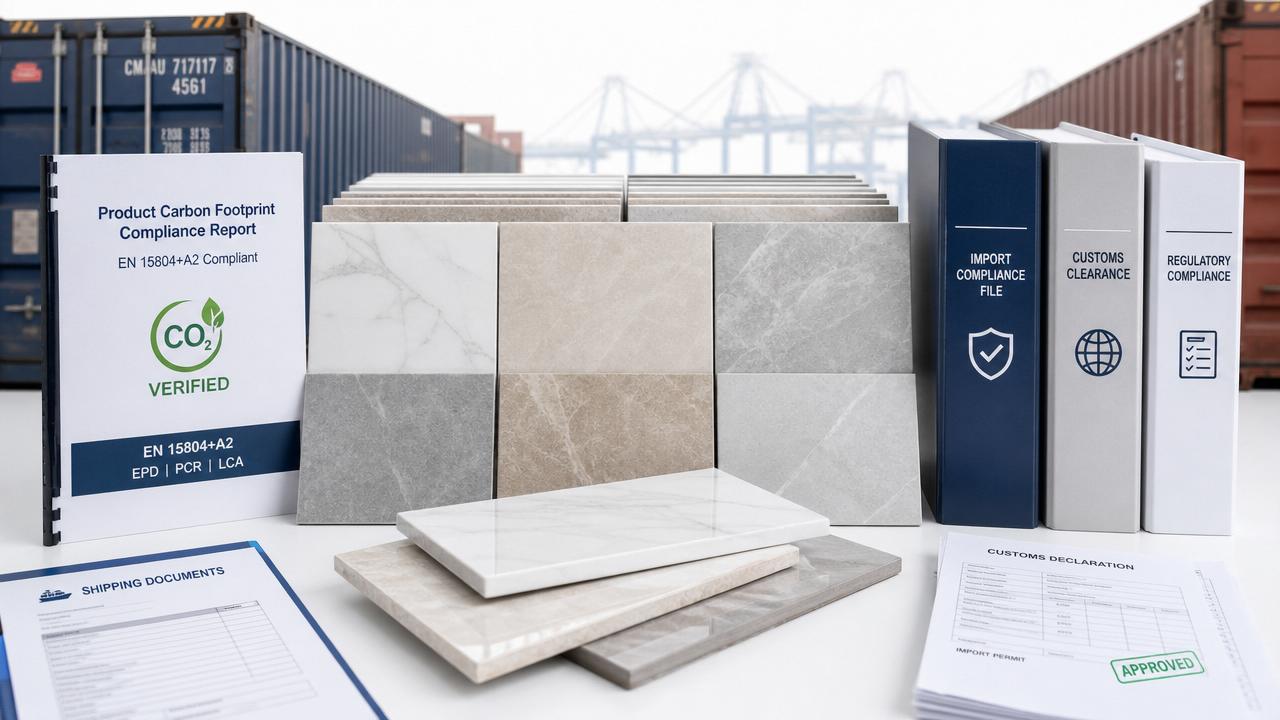
On June 12, 2026, the import regime for ceramic tiles in the Philippines, Malaysia, and Thailand shifts in a way that deserves close attention from exporters, buyers, certification-related service providers, and supply chain operators. The change is not only about customs paperwork: imported ceramic tiles are now tied to mandatory carbon footprint disclosure and proof of conformity with EN 15804+A2, while non-compliant shipments face customs delays of more than 15 working days. For companies serving ASEAN markets, especially Chinese tile exporters, this is a practical compliance and delivery issue rather than a routine trade update.
What is confirmed from the June 12 rule change
According to the provided event summary, the Philippines, Malaysia, and Thailand simultaneously upgraded import controls from June 12, 2026 for imported ceramic tiles. The stated requirement is that imported products must provide a carbon footprint declaration together with proof of conformity with EN 15804+A2. The same summary states that shipments failing to meet the requirement may face customs clearance delays of more than 15 working days.
The provided information also indicates that the move is directly relevant to Chinese ceramic tile exporters. It further states that in 2025, China’s ceramic tile exports to ASEAN accounted for 35.2%, and that the new rule is expected to raise compliance costs and lengthen delivery cycles.
Where the pressure is likely to appear first in the trade chain
Export-facing tile suppliers will face tighter document readiness requirements
From an industry perspective, the most immediate impact is likely to fall on exporters shipping ceramic tiles into the three markets named in the event. The reason is straightforward: the new import control is linked to specific carbon and conformity documentation, so the risk point moves forward from border inspection alone to pre-shipment document preparation. What deserves closer attention is whether export teams can present carbon footprint statements and EN 15804+A2-related proof in a way that matches importer and customs expectations.
Importers and buyers may need to reassess delivery timing and purchase planning
For importers, distributors, and procurement teams, the rule change matters because a non-compliant shipment is not described as merely non-preferred; it is associated with customs delays exceeding 15 working days. Analysis shows that this can affect purchase scheduling, inventory planning, and supplier selection. Buyers may therefore pay closer attention to whether suppliers can provide complete compliance files before shipment rather than after arrival.
Certification and testing-related service work may become part of routine transaction support
Observably, the requirement for carbon footprint declarations and EN 15804+A2 conformity proof can increase the importance of certification, documentation review, and technical file support in ceramic tile trade flows. The provided information does not specify execution details, but the rule change clearly makes compliance evidence more central to market access and customs handling.
Logistics and customs coordination may become more sensitive to document gaps
Supply chain service providers, including customs coordination and shipment planning roles, may also be affected because the stated consequence of non-compliance is customs delay. In practical terms, this means document completeness, filing sequence, and handoff timing may become more important in delivery planning, even if the full enforcement approach has not been detailed in the input.
What companies should monitor before treating this as routine
Check whether existing product files can support the new entry requirements
Analysis shows that companies should first review whether current export documentation for ceramic tiles can support the required carbon footprint declaration and EN 15804+A2 conformity proof. This is not yet a broad management issue; it is a transaction-level question affecting whether shipments can move without avoidable customs friction.
Watch for changes in importer requests and tender documentation
What deserves closer attention is whether importers, distributors, and project buyers begin to reflect the new requirement in RFQs, purchase terms, technical documents, or bid materials. Even where the official rule language is already signaled by the event summary, market execution often becomes visible first through document requests and commercial screening.
Recalculate lead times where customs delay risk is material
Because the provided summary explicitly mentions clearance delays of more than 15 working days for non-compliant products, exporters and buyers should pay attention to delivery promises, booking windows, and buffer time in ongoing business. This does not confirm a uniform outcome for every shipment, but it does indicate that delivery planning can no longer be separated from compliance preparation.
Review supplier qualification through a compliance lens
For companies sourcing from multiple manufacturers, it is more appropriate to understand this development as a supplier qualification issue as well as a border entry issue. The key practical question is not only price or production capacity, but whether the supplier can consistently support the required carbon and conformity documentation for the target market.
Why this looks like an execution signal, not just a headline
Observably, this development is better understood as an implemented market-entry signal than as a theoretical policy discussion, because the provided information includes a start date, named markets, specific documentation expectations, and a stated customs consequence for non-compliant goods. At the same time, analysis shows that the market still needs to watch how these requirements are interpreted in practice, especially around documentation format, review thresholds, and transaction-level enforcement.
For the ceramic tile trade, the significance of the update is not limited to whether a new requirement exists. What deserves closer attention is that carbon-related disclosure and EN 15804+A2 proof are being tied more directly to import handling and delivery certainty. That makes the issue relevant across compliance, procurement, shipping, and customer commitment processes.
How this update is best understood for now
At this stage, the event is best read as a concrete compliance and customs-access development affecting ceramic tile trade into three Southeast Asian markets. It does not by itself establish every enforcement detail, and it should not be overstated as a fully settled long-term market outcome. A more neutral reading is that the rule change raises the cost of incomplete documentation, increases the value of compliance readiness, and may extend delivery risk for exporters and buyers that are not prepared.
Basis of this article and what still needs verification
This article is generated from the user-provided news title, event date, and event summary. For developments of this kind, relevant source types usually include official notices, releases from regulatory authorities, customs or trade administration information, industry association updates, standard organization documents, and reporting by established professional media. No specific official source link was provided in the input, so the exact official publication path still needs to be verified on an ongoing basis.
Further observation is still needed on detailed implementation rules, certification interpretation, customs execution standards, tender document changes, market feedback, and how exporting companies are able to meet the documentation requirement in actual transactions.
Industry Briefing
Get the top 5 industry headlines delivered to your inbox every morning.